

Table of Contents
- Why Shop Independent Artist Clothing Online
- How to Vet Independent Artist Clothing Shops Before You Buy
- Best Independent Clothing Brands: What Sets Them Apart
- Wearable Art Fashion Trends Shaping Style in 2026
- How to Style Graphic Tees and Art-Forward Pieces
- Building a Curated Collection: Art-to-Wear for Every Day
- Frequently Asked Questions
Last Updated: September 11, 2026
Why Shop Independent Artist Clothing Online
Shopping independent artist clothing online means buying garments where the artwork, cut, and production choices come from a named creative rather than a mass-market design team. This guide from JRStudio covers how to find those pieces, vet a shop, and build a wardrobe around them.
Buyers increasingly prefer a few distinctive pieces over a closet of identical basics, and print-on-demand and small-batch production let a single artist sell nationally without a factory contract. The risk: independent shops vary enormously in quality control, communication, and follow-through.
How to Vet Independent Artist Clothing Shops Before You Buy
Vet a shop by checking four things before you pay: who the artist is, how the garment is produced, what the return policy says, and whether the brand publishes verifiable contact details. A shop that answers all four is usually safe; one that dodges any is not.
Start with the artist. A legitimate label names the person behind the work and where they trained. JRStudio, for example, publishes work by Janet Richardson, MFA, who studied at Western Carolina University.
Then check the production story: fabric weight, printing method, where the blank was made, and whether the brand uses certified materials. Vague language like "premium quality" with no numbers is a warning.
Finally, read the return policy before checkout. Independent shops often have shorter windows than large retailers, and made-to-order items may be final sale, legitimate, but worth knowing going in.
Sustainability and Ethical Sourcing Verification
Sustainability claims are the hardest thing to verify in independent fashion, because no single certification covers an entire garment. Verify what you can: look for OEKO-TEX STANDARD 100 certification on the fabric, and check whether the brand names its printing partners and blank suppliers (oeko-tex.com).
Be skeptical of any shop that leads with "sustainable" and nothing else. The useful signals are specific and boring: certified cotton, garment-dyed rather than chemically washed, tubular knit construction that reduces fabric waste, and a stated country of manufacture. If a brand lists those details, it is usually doing the work; if not, treat the claim as marketing.
Artist Compensation Transparency
Artist compensation transparency means the shop tells you, at least in general terms, how the creative person is paid. Few labels publish exact numbers; look instead at whether the artist is the owner, a named collaborator, or an anonymous contributor whose work is licensed in bulk.
This separates an artist-led label from a dropshipper using "artist" as a keyword. When the artist owns the shop, your purchase supports them directly; when artwork is licensed from an unnamed source, the margin goes elsewhere.
A practical test: search the artist's name outside the shop's own site. An artist with a real practice will have a portfolio, exhibition history, or social presence that predates the store.
Best Independent Clothing Brands: What Sets Them Apart
The best independent clothing brands share three traits: a named artist, a consistent visual language across products, and production details they publish. Scale is not one of them, many of the strongest labels are run by one or two people.
What separates them from mass-market apparel is coherence. A large retailer sells hundreds of unrelated graphics tested for mass appeal; an independent label sells a body of work. A tee, a tote, and a hat from the same artist share a recognizable hand.
How to Find Emerging Talent Before Everyone Else Does
Most shoppers discover independent labels when an algorithm shows them a tee and they never learn who made it. That is backwards, the best collections come from treating discovery as a deliberate process, not a feed.
A workable discovery routine has four steps.
1. Start with the artist, not the product. Search the name on the label outside the shop's own site. A real practice leaves a trail: a portfolio, gallery listing, exhibition announcement, craft fair booth, or teaching credit. If the only results are the shop's product pages and a social account created last year, you are likely looking at a print-on-demand reseller using "artist" as a keyword.
2. Check the body of work, not the single item. Open the full catalog and look for a through-line: shared palette, line quality, subject. Ten products from the same hand is a label; ten that look like ten different people made them is a marketplace.
3. Read the production page like a spec sheet. The strongest labels publish fabric weight in ounces per square yard, the print method (screen print, DTG, discharge), the blank supplier, and the country of manufacture. Details mean the work is being done; adjectives alone mean marketing.
4. Look for a stated point of view. The best labels can say in one sentence what they make and who it is for. "Garment-dyed tees printed with original paintings about peace and travel" is a point of view; "premium apparel for everyone" is not.
Where to Actually Look
A few channels consistently surface emerging talent before it reaches the mainstream:
- Regional craft fairs and art walks. Artists who sell in person usually sell online too, and the booth is the fastest way to judge quality and meet the maker.
- Juried art markets and open studio events. These filter for artists with a real practice, not just a storefront.
- Museum and gallery gift shops. Curators vet the artists they carry, doing the discovery work for you.
- Artist-run newsletters and studio mailing lists. Small labels often announce new work to their list before it hits the shop.
- Niche subreddits and forums for printmaking, illustration, and textile art. Artists post process photos there, a strong signal of real production.
A Comparison Framework You Can Reuse
When you have two or three candidate labels, run them through the same five checks to separate a label worth returning to from one that will take your money and disappear.
| What to Check | Strong Signal | Weak Signal |
|---|---|---|
| Artist identity | Named, verifiable practice | "Designed by our team" |
| Production detail | Fabric weight, print method, origin | "Premium materials" |
| Certification | OEKO-TEX, stated scope | Unnamed "eco" badge |
| Return policy | Clear window and conditions | No policy page |
| Contact | Real address or form with response time | Social DMs only |
What "Emerging" Actually Means
Emerging does not mean new. It means the artist is still building a body of work and still controls production, the window where prices are reasonable, communication is direct, and pieces are genuinely limited. Once a label scales, the artist often becomes a creative director and the hand-made quality fades. Buying early is cheaper and how you end up with the pieces people later ask about.
Wearable Art Fashion Trends Shaping Style in 2026
Wearable art fashion trends in 2026 lean toward quieter, more personal pieces rather than loud statement graphics: earth tones, garment-dyed fabrics, and prints that read like a painting rather than a logo.
Three directions stand out: painterly figurative work (a single figure or scene closer to a gallery print than a slogan), back-print designs where the front stays clean and the artwork lands across the shoulders, and small accessories that carry the same artwork at a lower price point.
There is also a shift toward unisex cuts and relaxed fits: independent labels increasingly cut one pattern for everyone rather than separate men's and women's lines, keeping production small and pricing reasonable.
Why These Trends Are Happening Now
Trends in independent fashion are driven by production economics, not runway cycles. Three forces shape what you see on shop pages this year.
Print-on-demand matured. Direct-to-garment (DTG) printing now holds detail well enough that a painterly figure survives the wash cycle; five years ago it was fine for flat graphics and poor for gradients and brushwork (peer-reviewed research). That shift is why figurative prints are everywhere.
Garment dyeing got cheaper at small scale. Garment-dyed blanks are washed after construction rather than dyed as fabric first, giving each piece a slightly different tone and a softer hand. Runs of 50 to 200 units are now economical, exactly the volume an independent label needs.
Buyers pushed back on logos. Many shoppers now prefer a piece that reads as artwork rather than advertising, so independent labels moved the print to the back, shrank the front, and treated the garment as a canvas rather than a billboard.
How to Tell a Real Trend from a Marketing Claim
Not every shop using the word "wearable art" is selling it. A few checks separate the two.
- Look at the print method. Screen print and DTG hold painterly detail. Heat-transfer vinyl and sublimation flatten brushwork into a sticker-like image.
- Look at the fabric weight. A garment-dyed tee worth the price usually runs 5.5 to 6.5 ounces per square yard. Anything under 5 ounces will feel thin after a few washes.
- Look at the construction. Tubular knit (no side seams) reduces fabric waste and holds shape better than a cut-and-sew tee (peer-reviewed research). Side-seamed tees fit closer to the body; tubular tees fit boxier.
- Look at the color story. A real collection shares a palette across pieces. A shop with a different color scheme on every product is sourcing blanks, not building a body of work.
What to Buy If You Want to Follow the Trend Without Regret
Trend pieces age fast when they are loud. The ones that hold up are tied to a specific artist's body of work rather than to a moment.

A practical approach: pick one painterly piece as an anchor, then add accessories that repeat the palette. A back-print tee works under a solid overshirt for three seasons; a pin or embroidered beanie carries the same artwork at lower cost. Unisex cuts are the safest fit bet, boxier through the chest, shorter in the body, layering well over denim and under jackets.
If you are unsure whether a trend will last, ask one question: does the piece still look good if you cover the graphic? If yes, the cut and color are doing the work and it will survive the trend cycle. If no, you are buying the print, not the garment.
How to Style Graphic Tees and Art-Forward Pieces
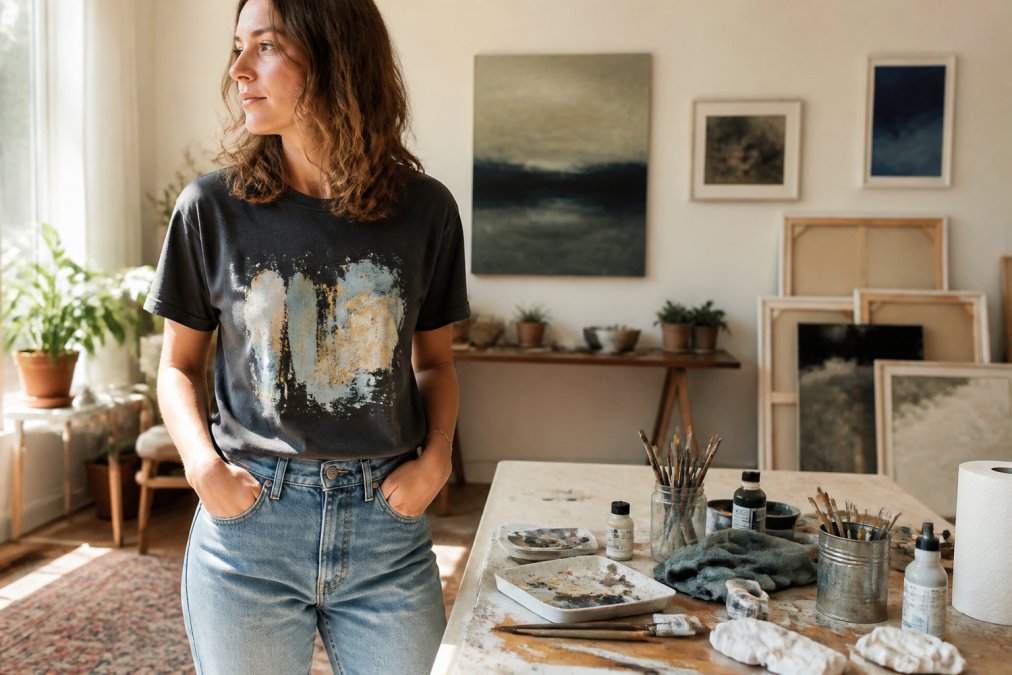
Style a graphic tee by treating the print as the focal point and keeping everything else plain. One art-forward piece per outfit is almost always enough.
The easiest formula: a printed tee, dark denim or neutral trousers, and one accessory that echoes the artwork's palette. Warm browns and golds pair with a matching cap or canvas tote without competing.

For back-print designs, keep the front completely clean. The artwork lands across the shoulders, so a simple jacket worn open frames the print instead of hiding it.
Layering is where most people go wrong: a patterned flannel over a graphic tee creates two competing focal points. If you want a layer, choose a solid color pulled from the artwork itself.
A few combinations that work consistently:
- Painterly front print plus raw denim and plain sneakers
- Back-print tee under an open solid overshirt, print visible at the shoulders
- Art tote carried with an otherwise monochrome outfit
- Embroidered beanie as the only patterned element on a cold-weather look
- Small pin on a denim jacket collar for a low-commitment version of the same idea
Sizing and Fit Challenges for Independent Brands
Sizing is the biggest friction point when you shop independent artist clothing online. Small labels often use one blank supplier, and that cut may run differently from the mainstream brands you know.
The fix is to ignore the letter on the tag and read the measurements. A well-run shop publishes chest width, body length, and sleeve length in inches per size. Compare those numbers against a garment you already own and like, not against your body.
Two more things: garment-dyed cotton can shrink slightly on a first cold wash, so pre-shrunk blanks matter, and unisex cuts are usually boxier through the chest and shorter in the body than a women's cut, a feature for some buyers, a dealbreaker for others.
If a shop does not publish a size chart with numbers, email before ordering rather than guess.
Building a Curated Collection: Art-to-Wear for Every Day
Build a curated collection by starting with one anchor piece and adding items that share its palette, expanding only when a new piece genuinely combines with what you own. Most people do this backwards, buying singles that never work together.
The anchor is usually a tee, because it gets the most wear. From there, add one accessory in the same color family and one item in a different category, such as a bag or a hat.
JRStudio's "Walk for Peace" collection shows how this works in practice. The Walk for Peace T-Shirt at $24.98 anchors the set with a painterly monk and dog scene in earthy browns and golds on a heavyweight garment-dyed cotton tee. The cotton canvas tote at $26.13 repeats the same artwork on one side and the single word "Peace" on the other. A pin button at $5.99 gives you the same motif on a smaller scale for a jacket or bag.

That is a three-piece collection for under $60, and every piece works with the others. For a version that reads more like a gallery print, the back-design garment-dyed tee at $29.98 keeps the front clean and puts the artwork across the shoulders.
For gifts, this approach solves the "will they actually use it" problem: a piece that fits an existing interest, travel, cooking, a personal cause, gets used, while a generic graphic does not.
Finding independent artist clothing online is easy. Finding shops worth returning to comes down to the same checks every time: a named artist, published production details, a clear return policy, and a palette that fits your wardrobe. JRStudio builds its collection around exactly that idea, with original artwork by Janet Richardson, MFA, printed on garment-dyed tees, canvas totes, and embroidered accessories designed to combine rather than compete. Shop our latest arrivals and start with one anchor piece you will wear every week.
Frequently Asked Questions
What are the benefits of buying clothing from independent artists?
Buying from independent artists means you get original artwork, not mass-produced designs. You support a real person directly, often a small studio or solo creator. Independent artist clothing tends to use small-batch or made-to-order production, which reduces waste. You also get pieces that reflect personal expression rather than trend cycles. Many independent shops, like JRStudio, print original paintings onto garments, so each piece carries a story you can wear.
How do I know if an independent artist clothing shop is legitimate?
Check for a named artist with a verifiable background, clear product descriptions, and real customer reviews. Read the return policy before buying. A shop that explains its production process, names its materials, and shows the artist's portfolio is usually trustworthy. If the site only has generic stock photos and no artist info, proceed with caution.
Is artist-designed clothing considered sustainable fashion?
It can be. Many independent artists use small-batch production, print-on-demand, or made-to-order methods that avoid overstock waste. Some use organic or OEKO-TEX certified cotton and garment-dyed processes that reduce water use. However, sustainability depends on the specific shop. Look for transparency about materials, production location, and shipping practices. Artist-designed clothing is often more sustainable than fast fashion simply because it is produced in smaller quantities.
How can I style graphic tees from independent artists?
Start with a relaxed fit tee featuring original artwork, then balance it with neutral bottoms like dark denim or linen trousers. Layer under an open flannel or denim jacket for cooler days. For a gallery-ready look, tuck the front slightly and add simple accessories. Let the art be the focal point, so keep other pieces understated. Garment-dyed tees in earthy tones pair especially well with natural fabrics and minimal jewelry.
What should I check before buying clothing from a new independent brand online?
Verify the size chart against your own measurements, not your usual size, since independent brands often run differently. Read the return and exchange policy carefully. Check shipping times and costs, especially for made-to-order items. Look at fabric weight and care instructions to ensure the piece fits your lifestyle.