

Table of Contents
- Choose the Right Spot: Focal Points, Eye Level, and Room Flow
- Hanging Hardware and Tools: J-Hooks, Nails, and Wire
- How to Hang Canvas Art Without Nails
- Canvas Print Framing Ideas: Floating Frames, Propping, and Shelves
- Gallery Wall Layout Tips for Multi-Panel and Triptych Art
- Lighting, UV Protection, and Long-Term Preservation
- Frequently Asked Questions
Last Updated: September 17, 2026
Choose the Right Spot: Focal Points, Eye Level, and Room Flow
The single most common mistake with display canvas prints is treating the wall as empty space to fill rather than a surface to compose. A canvas needs a job: anchor a seating area, greet guests in an entryway, or balance a piece of furniture. Hang it where the eye already travels, and the room feels intentional. Hang it where it doesn't belong, and even great art looks like an afterthought.
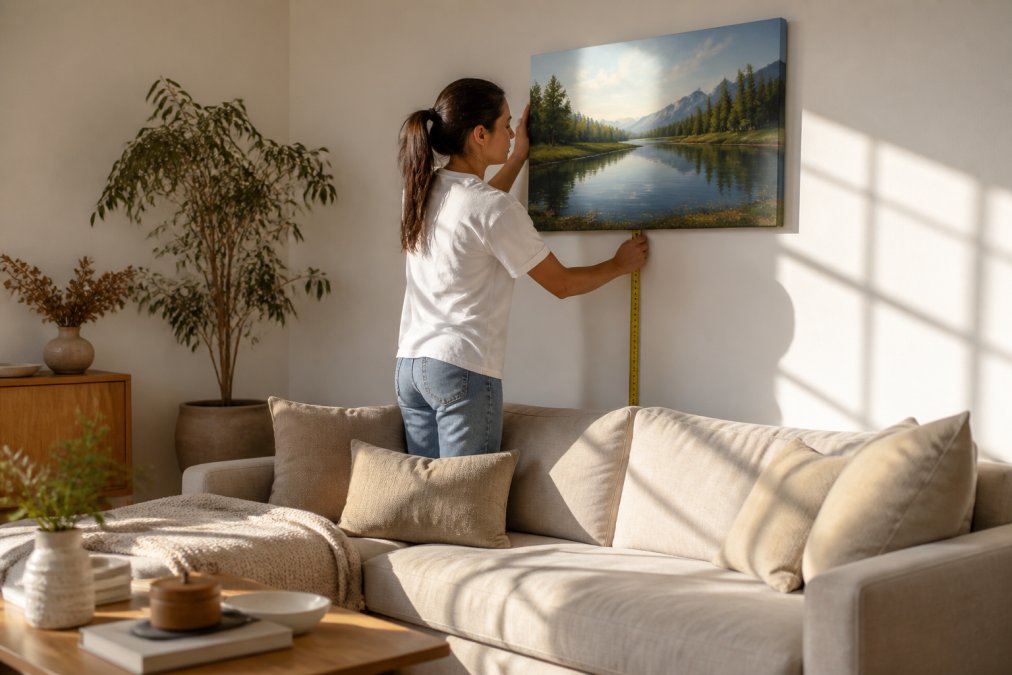
A few placement principles worth committing to memory:
- Anchor to furniture, not to the ceiling. Leave 6 to 10 inches between the bottom of the frame and the top of a sofa, console, or headboard.
- Respect room flow. Don't hang art where a door swing, a walking path, or a light switch will interrupt it.
- One focal point per wall. If a fireplace or window already commands the room, let the canvas support it rather than compete.
Hanging Hardware and Tools: J-Hooks, Nails, and Wire
Selecting the right hanging hardware comes down to two questions: how much does the piece weigh, and what is the wall made of? Most framed canvases in the 10" x 8" to 24" x 18" range arrive with sawtooth hardware already attached, which means a single nail or a small hook is often sufficient. Larger pieces call for more deliberate choices.

Here's how the common options compare:
| Hardware | Best For | Wall Type | Notes |
|---|---|---|---|
| Sawtooth hanger (included) | Small to medium canvases | Drywall with a nail | Simplest option; already attached on many framed prints |
| J-hooks | Framed canvases with a lip | Drywall or plaster | Holds the frame edge securely; easy to reposition |
| Picture hanging wire | Wide or heavy frames | Drywall with anchors | Distributes weight across two points |
| Drywall anchors | Anything over a few pounds | Drywall | Required when no stud is available |
| Command strips | Lightweight, rental-friendly | Smooth, painted walls | No holes; check the weight rating carefully |
Weight-Bearing Capacity by Wall Type
This is the part most guides skip, and it's the part that decides whether your canvas stays up. The load a wall can carry depends less on the fastener than on what the fastener is biting into.
- Drywall (gypsum board). Bare drywall is the weakest common substrate. A single nail in 1/2-inch drywall holds only a light frame and will wallow out over time. Self-drilling drywall anchors rated for 20 to 50 pounds are the practical fix for medium pieces; for anything heavier, drive into a stud. Studs are typically spaced 16 inches on center, though 24-inch spacing appears in some newer construction, so verify rather than assume.
- Plaster and lath. Older plaster is denser and grips a screw better than drywall, but it is brittle and cracks if you drill without a pilot bit or hammer too close to an edge. A masonry bit on a low clutch setting, plus a plastic anchor, handles most medium canvases. Lath behind the plaster can be surprisingly strong once the anchor seats.
- Brick and concrete block. These need a masonry bit and a plastic or lead sleeve anchor. Drill slightly deeper than the anchor length, blow out the dust, and seat the anchor flush. A canvas that would sag on drywall can hang confidently here.
- Poured concrete. The hardest case. A carbide or diamond bit and a hammer drill are usually required, and a drop-in or sleeve anchor is the reliable choice. This is also where a French cleat earns its keep, because it spreads load across a long horizontal run instead of concentrating it at two points.
Matching Hardware to Canvas Size
A rough working pattern most installers follow: small canvases up to about 12 x 12 inches hang fine on a single sawtooth and nail; medium pieces up to roughly 24 x 36 inches do better on two hooks or a wire rated above the piece's weight; and anything larger, or any piece with glass, should use a French cleat or two stud-mounted hooks.
How to Hang Canvas Art Without Nails
How to hang canvas art without nails: use adhesive strips rated for the canvas weight, lean the piece on a picture ledge or shelf, or mount it on a French cleat or hook system that distributes load without a single nail hole. Each method suits a different situation, and each has a removal process worth understanding before you commit.
Damage-Free Options for Renters
Renters face a real constraint: every hole is a future deduction. Adhesive strips work well for lightweight canvases, provided you follow the weight rating on the package and clean the wall first. For anything heavier, a picture ledge or floating shelf lets you lean the canvas rather than hang it, and it looks deliberate rather than improvised.
Removing Adhesive Hardware Without Damaging Drywall or Paint
This is the step most guides leave out, and it's the one that decides whether you get your deposit back. The mechanism matters: adhesive strips hold by stretching, and they release by stretching too. Pull straight down along the wall, slowly, at a steady angle, never out toward you. Pulling outward is what tears paint and leaves a divot.
A workable sequence:
Copy of Abstract Military Figures Matte →
- Warm the adhesive first. A hair dryer on low, held a few inches away for 30 to 60 seconds, softens the bond and makes the strip release with less force. This matters most in cold rooms, where adhesive turns brittle.
- Stretch the tab down, not out. Keep the tab parallel to the wall and pull slowly. The strip should elongate to several times its original length. If it snaps, you're pulling too fast or at the wrong angle.
- If the strip snaps, don't pry. Work the remaining adhesive loose with dental floss or fishing line sawed gently behind the tab, then lift the frame away.
- Remove residue with a mild solvent. A little rubbing alcohol on a soft cloth lifts most adhesive residue without dulling the paint. Test on an inconspicuous spot first, especially on flat or matte finishes.
- Patch only if needed. A clean removal usually leaves nothing to fix. If a small patch is required, lightweight spackle, a fingertip-smooth edge, and a matching paint touch-up handle it.
Weight Limits by Wall Type
Drywall holds the least without reinforcement. A single nail in bare drywall can support a light frame, but anything substantial needs an anchor or a stud. Plaster is denser and grips better, though it cracks if you drill without care. Brick and concrete require a masonry bit and a plastic or lead anchor. When in doubt, find a stud with a magnetic stud finder, which locates the drywall screws rather than the stud edges.
Canvas Print Framing Ideas: Floating Frames, Propping, and Shelves
Framing changes how a canvas reads in a room. A floating frame leaves a visible gap between the canvas edge and the frame, which gives a stretched print a gallery-like presentation without the cost of traditional matting. It's the best choice if you want the artwork to feel finished but still modern.
Gallery Wall Layout Tips for Multi-Panel and Triptych Art
Gallery wall layout tips start with one rule: lay the whole arrangement on the floor before you touch the wall. Multi-panel and triptych pieces only work when the spacing between panels matches the spacing between the art and the furniture below it.
Spacing, Alignment, and Visual Balance
Two to three inches between frames is the standard for a tight, unified gallery wall. Wider spacing of four to six inches reads as a looser, more contemporary arrangement. Pick one and repeat it exactly, because inconsistent gaps are what make a gallery wall look accidental.
Lighting, UV Protection, and Long-Term Preservation
Canvas prints fade when ultraviolet light hits the inks, and direct sunlight is the worst offender. Position pieces away from windows that receive hours of direct sun, or accept that colors will soften over time. For high-value or irreplaceable work, UV-protective glass in a traditional frame offers the strongest defense.
Frequently Asked Questions
How do I display a canvas print without damaging my walls?
Use damage-free adhesive strips rated for the canvas weight, or install a picture rail and hang with cord. For heavier pieces, try a single small nail in a spot hidden behind the frame, then patch with spackle when you move. Command strips work well for prints under 4 pounds, but always check the weight rating on the package. When you display canvas prints in a rental, avoid drywall anchors that leave large holes.
What hardware do I need for hanging heavy canvas art?
For canvas over 10 pounds, use drywall anchors or toggle bolts rated for at least twice the weight of the piece. J-hooks work well for canvas with a wooden stretcher bar, while D-rings and wire are better for framed canvas. Always locate wall studs with a stud finder and drive screws into them when possible. If you cannot find a stud, use self-drilling anchors designed for your wall type.
Should canvas prints be framed or left unframed for a modern look?
Unframed canvas with clean edges suits modern, minimalist spaces, while a floating frame adds definition without hiding the art. For a gallery wall, mixing framed and unframed pieces creates depth. If you display canvas prints in a high-traffic area, a frame protects the edges from bumps. Matte finishes reduce glare, and UV-protective coatings help prevent fading over time.
How do I create a balanced gallery wall with canvas prints?
Start by laying all pieces on the floor and arranging them until the composition feels right. Keep 2 to 3 inches between frames and align the center of the group at eye level, around 57 inches from the floor. Use a level and painter's tape to mark placements before hanging. For multi-panel or triptych art, treat the whole set as one unit and center it on the wall.