

Table of Contents
- Why Buy Handmade Art? The Case for Small Batch
- Quality and Craftsmanship You Can Feel
- Small Batch vs. Mass-Produced and Print-on-Demand
- Sustainable Home Decor Benefits: Less Waste, Better Materials
- Unique Gift Ideas for Art Lovers: One-of-a-Kind and Meaningful
- Durability, Care, and the Real Cost of Small Batch Goods
- Conclusion
- Frequently Asked Questions
Last Updated: September 14, 2026
Why Buy Handmade Art? The Case for Small Batch
Walk into any big-box home store and you'll see the same vase, the same print, the same throw pillow in a thousand other living rooms. Small batch artist goods offer the opposite: objects made in limited production runs, where a human hand shaped the design and a real name sits behind it. At JRStudio, artist Janet Richardson, MFA, builds her collection around exactly that idea, printing original paintings onto totes, tees, blankets, and canvas.
The appeal runs deeper than aesthetics. According to research on craft consumption and consumer wellbeing, buyers of handmade objects consistently report stronger emotional attachment to their purchases than buyers of mass-produced equivalents. That attachment changes how you use an object, how long you keep it, and how you feel when you see it on your shelf.
Below, we break down what small batch production actually delivers: better materials, less waste, genuine uniqueness, and pieces that hold up for years.
Quality and Craftsmanship You Can Feel
Craftsmanship shows up in the details you can touch. A heavy 12 oz cotton canvas tote feels structurally different from a thin promotional bag the moment you load it with groceries. Reinforced double-stitched handles, boxed corners, and a sewn-in label are the small signals that separate a piece built to last from one built to a price.

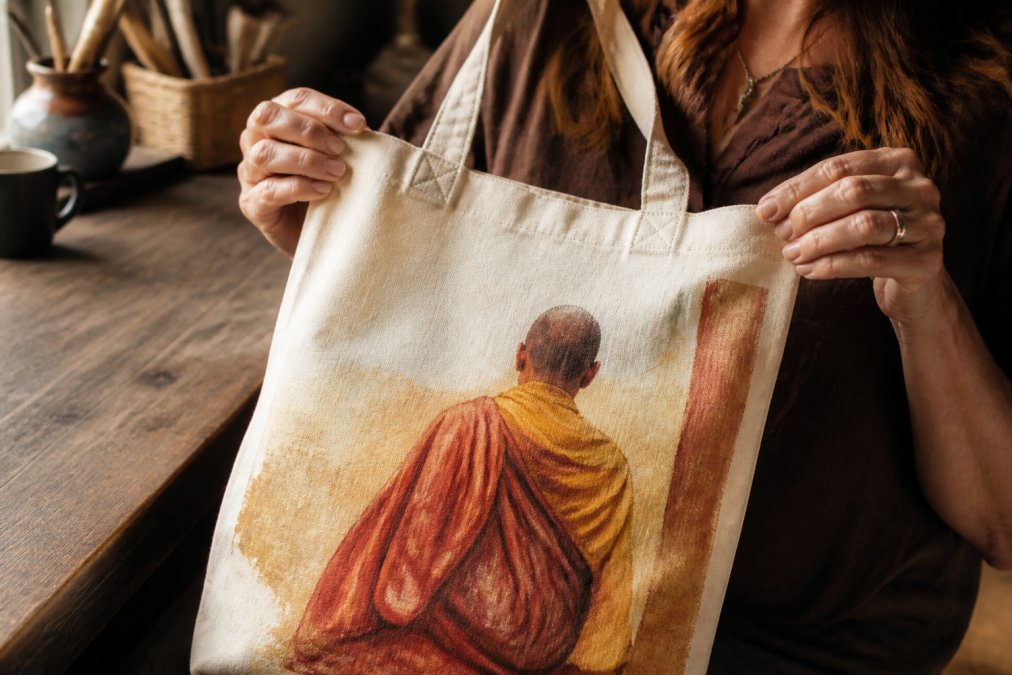
What most shoppers miss is that material weight is the single best predictor of longevity in textile goods. A 6.1 oz garment-dyed cotton tee holds its shape through repeated washing in a way that lighter fabric does not (FabricLink: Textile Dictionary). That's not marketing language. It's thread density.
Consistency, Quality Control, and Production Runs
Consistency is the quiet challenge of small-scale manufacturing. When you produce in small runs, every unit gets inspected rather than sampled. A maker working in batches of dozens can catch a misaligned print or a loose seam before it ships, something impossible at a scale of tens of thousands.
That's also why small batch goods vary slightly from piece to piece.
Small Batch vs. Mass-Produced and Print-on-Demand
Small batch production sits between two extremes: mass manufacturing and print-on-demand. Each model trades off differently on cost, uniqueness, and waste.
| Model | Typical Run Size | Uniqueness | Upfront Cost | Waste Profile |
|---|---|---|---|---|
| Mass-produced | Thousands+ | Low, widely duplicated | Lowest per unit | High, unsold inventory discarded |
| Small batch | Dozens to low hundreds | Moderate to high | Higher per unit | Low, produced to demand |
| Print-on-demand | One at a time | Low, infinitely repeatable | None for the seller | Low, but no edition limit |
The trade-off is honest: small batch goods cost more per unit because the maker absorbs design time, material quality, and limited-run economics. What you get in return is a piece that isn't sitting in a warehouse by the pallet.
Where print-on-demand falls short is exclusivity. A POD design can be reprinted forever, so owning one carries no sense of a limited edition.
Sustainable Home Decor Benefits: Less Waste, Better Materials
Sustainable home decor starts with production volume, not recycling labels. The environmental case for small batch is mostly a waste-reduction case, and the mechanism is straightforward: overruns.
Mass production runs are sized to hit a unit-cost break, not to match demand. A factory might print 10,000 units because the per-unit price only pencils out at that volume, then warehouse the surplus. Some of it sells at full price, some gets marked down, some goes to off-price liquidators, and the remainder is destroyed or landfilled. The EPA's guidance on reducing waste through thoughtful purchasing frames the consumer side of this simply: buying fewer, better-made items lowers total material throughput. Small batch inverts the factory logic. A maker producing dozens to low hundreds can size a run to actual demand, so there is no pallet of unsold inventory waiting for a landfill.
Where the Material Savings Actually Come From
Raw material choices matter as much as run size, and they compound. Heavyweight cotton canvas, ring-spun cotton, and museum-grade archival paper are selected because they last, not because they're cheap. A poster printed on 175 g/m² archival paper with pigmented inks resists fading in a way that thin commercial stock does not, which means you replace it less often. Fewer replacements means fewer raw-material harvests, fewer dye baths, fewer print runs, and fewer shipments over the life of the object.
The Trade-Off You Should Know About
Small batch is not automatically the lowest-footprint option for every purchase. Per-unit shipping emissions are higher when goods move in small quantities rather than full truckloads, and small makers often cannot negotiate the consolidated freight that large brands use. The honest framing is that small batch wins on overproduction and material longevity. For a durable home decor piece you keep for years, the overproduction savings usually dominate. For a disposable item you replace seasonally, they do not.
For home decor, that translates to one well-made canvas instead of three disposable prints, and a tote that outlasts a stack of promotional bags.
Unique Gift Ideas for Art Lovers: One-of-a-Kind and Meaningful
The best gift for an art lover is one that reflects a specific interest rather than a generic occasion. Artist-designed goods work because the artwork itself carries a subject, a mood, and a story the recipient can connect to. But the part most gift guides skip is what happens after the wrapping comes off.
The Storytelling Advantage of a Known Maker
When a recipient can name the person who made an object, the object stops being a product and becomes a narrative. Researchers who study craft consumption and consumer wellbeing have found that buyers of handmade objects report stronger emotional attachment to their purchases than buyers of mass-produced equivalents, and that attachment changes how the object is used, displayed, and kept. A mass-produced print has no author to point to. A small-batch print has a name, a studio, a run size, and often a note about the painting it came from.
That story is what turns a gift into a conversation piece. The recipient does not just own a canvas; they own the reason it exists. In practice, that means they hang it instead of storing it, wear the tee instead of saving it for a special occasion, and mention the artist when someone asks where it came from. The gift keeps working long after the occasion passes.
How to Choose a Piece That Carries a Story
A few directions that land well, with the storytelling hook attached:
- A canvas tote featuring an original painting, useful daily and personal in a way a gift card never is, and easy to explain when someone asks about the print
- A garment-dyed tee with a back print, wearable art that starts conversations and signals a specific taste rather than a generic logo
- A stretched canvas print for someone building a gallery wall, where the artist's name becomes part of how they describe their collection
- A plush velveteen blanket that turns a painting into something they use every evening, so the artwork lives in daily routine rather than on a wall
- An embroidered knit beanie with a small motif, subtle enough for daily wear and specific enough to feel chosen
The Limited-Run Signal
Scarcity does real work here, provided it is honest. The recipient knows their piece is one of a finite number rather than one of an infinite reprint. That is different from manufactured exclusivity, where a brand artificially withholds stock to create urgency.

That is the difference between a gift that gets used and one that gets politely forgotten.
Durability, Care, and the Real Cost of Small Batch Goods
Durability is where the higher upfront cost of small batch goods pays itself back. A heavyweight canvas tote or a 6.1 oz cotton tee survives years of regular use, which spreads the purchase price across far more wears than a cheap alternative that fails in a season.

The real cost calculation isn't sticker price. It's cost per year of use. A $26.13 cotton canvas tote carried daily for five years costs a few dollars annually. A $10 bag replaced twice a year costs more and generates more waste. Consumer value in this category is measured over time, not at checkout.
Caring for Your Artist-Made Pieces
Proper care extends the life of printed and dyed goods considerably.
- Machine wash cold, at or below 90°F, and turn printed garments inside out
- Do not bleach, and avoid dry cleaning on garment-dyed cotton
- Tumble dry low or line dry; high heat degrades both fabric and print
- Spot clean canvas totes and never iron directly over a printed area, since the print can stick to the iron
- Wipe posters gently with a clean, dry cloth rather than a damp one
Conclusion
Buying small batch artist goods is a decision about what you want your home and wardrobe to say. Mass-produced items are cheaper and easier to replace. Small batch pieces cost more upfront but carry real craftsmanship, lower waste, and a story tied to an actual artist. JRStudio, founded on the original work of Janet Richardson, MFA, offers wearable clothing, household items, and canvas prints that put that idea into daily use. Shop the latest arrivals and bring a one-of-a-kind piece into your everyday.
Frequently Asked Questions
What are the benefits of small batch products?
Small batch products offer better quality control, since every run gets closer attention than a mass-produced line. They use fewer raw materials and create less waste. You also get uniqueness: designs stay limited, so your piece feels personal rather than something thousands of other people own. For buyers, that combination of durability, sustainability, and exclusivity is what makes small batch artist goods worth the upfront cost.
Why do consumers prefer handmade artist goods over mass-produced items?
Handmade artist goods carry a story and a maker's name. Mass-produced decor is designed for volume; artisanal work is designed for the piece itself. Buyers also report that handmade items hold up longer, since materials like heavyweight canvas and garment-dyed cotton are chosen for durability rather than lowest cost. Supporting independent artists and the local economy adds another reason people choose handmade over mass-produced alternatives.
How does small batch production contribute to sustainability?
Small batch production reduces overstock and waste. Instead of printing thousands of units that may never sell, artists produce limited runs based on real demand, which cuts raw material use and landfill waste. That approach supports ethical consumption without sacrificing quality.
Is small batch production more ethical than mass manufacturing?
It often is, because small-scale manufacturing keeps more of the money with the artist and reduces the pressure to cut corners on labor or materials. Limited production runs also mean less waste and a shorter supply chain. That said, ethics depend on the specific maker.
The challenge with small batch goods is finding a maker whose work genuinely fits your space and style, not just your budget. JRStudio solves that with original artwork by Janet Richardson, MFA, printed on heavyweight cotton canvas totes, garment-dyed tees, stretched canvas prints, and velveteen blankets, each designed to blend artistic creativity with functional form. Get started with JRStudio and transform ordinary daily moments into something you actually look forward to using.